By Tonia Damvakeraki, PhD Researcher (University of Nicosia)
DAOs began as crypto-native instruments, such as DeFi protocols, NFT collectives, and token treasuries. Now, a quieter question is in play: can their governance logic (smart-contract rules, distributed voting, transparent treasuries) work for any organization? The honest answer is yes, but only unevenly, partially, and after confronting hard trade-offs.
By 2025, over 13,000 active DAOs held roughly $21.4 billion in liquid assets, spanning DeFi, gaming, housing, science, and environmental coordination [Han, Lee & Li, 2025, Journal of Corporate Finance]. Still, operational decentralization remains aspirational; most DAOs continue to rely on centralized bodies for critical decisions and on off-chain tools like Snapshot.
Sector outlook
Private corporations can gain transparency and reduce principal-agent friction through on-chain shareholder voting and smart-contract-enforced treasury actions. The catch: token-weighted voting reproduces concentrated power, the whale problem, with governance attacks already causing over $90 million in losses in 2025. Legal personhood gaps remain the binding constraint; proposals like the UK DAOLLP model are still theoretical.
NGOs and civil society show the strongest fit, with charity and impact DAOs distributing more than $35 million globally and 500 to 600 environmental DAOs operating worldwide. The risks vary: donor accountability laws (EU, OECD) require legal persons, and early DAOs have at times reproduced the exclusionary dynamics they sought to dismantle.
Public administration is the hardest case. Constitutional accountability is incompatible with immutable code, and average DAO turnout is below 18%. The realistic role is to enable procurement transparency, participatory budgeting, and tamper-resistant registries within conventional legal frameworks.
Cooperatives and community governance are the most suitable frontier; the Hypha DAO 3.0 design demonstrates how modular voting and trust-based safeguards address earlier fairness failures [Bennett, 2025, Frontiers in Blockchain]. DeSci DAOs offer structural remedies for non-transparent peer review and grant allocation but inherit the same legal and participation risks.
Cross-cutting reality
Across sectors, the top 15 – 20 percent of token holders’ control about 78 percent of voting power. DAOs aspire to be value-governed communities but operate as incentive-driven markets. The shift from token-weighted voting to reputation-based, role-differentiated, and quadratic voting will probably be the determining factor on whether DAOs deliver democratic governance or rebrand plutocracy.
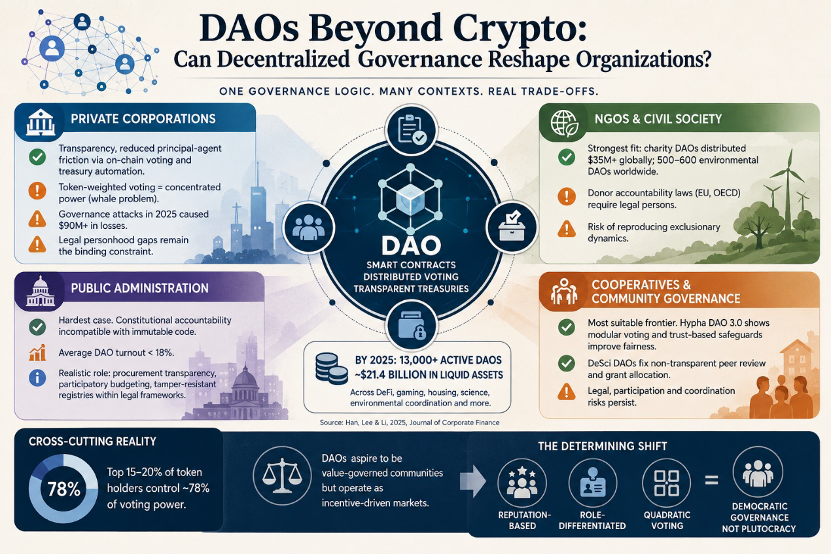
Figure Credit: “Visual illustration created with the assistance of OpenAI’s ChatGPT and AI image generation tools, based on the author’s conceptual direction”