
Why award-winning VR rarely finds its audience and what my PhD is trying to do about it
By Byron Chrysovergis · DC13, Agora Doctoral Network · University of Nicosia
Most discussions of virtual reality begin with hardware. Headset specs, resolution, comfort, price. The implicit promise is that once the device gets good enough, the medium will arrive.
Inside the cultural side of VR, the cinematic 180/360 films, spatial performance recordings, and documentary works that play at festivals like Venice Immersive, Sundance, IDFA DocLab, and Cannes, the bottleneck has shifted. The works exist. They win awards. They are produced at festival-grade quality. What remains structurally unsolved is the journey from premiere to audience.
That gap is the subject of my PhD.
Two channels, two logics
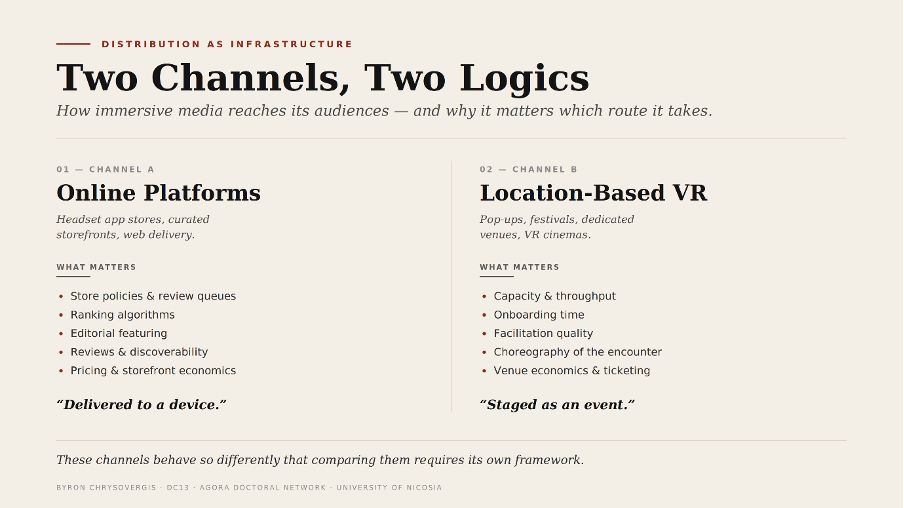
Immersive artistic works circulate through two dominant routes, and they could not be more different from each other.
Online platforms: headset app stores, curated storefronts, and web delivery, operate as platform ecosystems. Visibility depends on store policies, ranking algorithms, editorial featuring, and the slow accumulation of reviews. The work is delivered to a device the viewer already owns, in a context the viewer chooses.
Location-based VR: pop-ups, festivals, dedicated venues, and VR cinemas, operate on an entirely different constraint set. The decisive variables are not clicks but capacity, onboarding time, hygiene, facilitation quality, and the choreography of a live encounter. Location-based VR is not delivered. It is staged.
Treating these as the same channel produces poor decisions. A title that performs well in a curated pop-up may struggle on a storefront, and vice versa. Yet the field still lacks a shared vocabulary for comparing them: what counts as a “view” when one channel measures store impressions and the other measures seated attendance? What does a fair price look like across a ticketed event and an app-store purchase? How should creators sequence their releases between the two?
Distribution as infrastructure, not logistics
My thesis treats distribution as infrastructure rather than logistics. Following platform scholars (Gawer, 2022; Cowls, Morley, Taddeo, & Floridi, 2023), distribution channels are not neutral pipes. They govern visibility. They allocate attention. They determine which works become legible to audiences and which do not.
That framing matters because it changes the kind of question worth asking. The question is no longer only “is the work good?” but “under what conditions does this channel make this kind of work findable, intelligible, and economically sustainable?” Outcomes are produced by interacting forces. Content quality, channel governance, audience expectations, venue operations, and rights design, rather than any single variable.
Methodologically, the work is critical realist and mixed-methods, structured around Context–Mechanism–Outcome reasoning (Pawson & Tilley, 1997). Three intervention contrasts are pre-specified: curated bundles versus single-title programmes, full versus light facilitation, and location-based-first versus online-first windowing. Each is paired with measurement instruments designed to travel between channels.
A puzzle that keeps returning
One pattern keeps surfacing in the early fieldwork. Award recognition at major festivals correlates poorly with platform-level legibility afterwards. Excellent works disappear. The mechanisms that translate festival prestige into sustained audience reach (mechanisms we take for granted in cinema and series television) do not, on the current evidence, work reliably for immersive media.
Understanding why, and proposing what would have to change, is one of the questions the PhD is built around. Part of the answer almost certainly lies in the venue infrastructure layer that immersive media still lacks at scale; part of it lies in the absence of cross-channel metrics that would let a distributor make a case to a venue, or a venue make a case to a funder, with a shared evidentiary basis.
What the next year looks like
The fieldwork is already underway. A stakeholder survey of distributors, venues, festivals, and producers is in its first wave. Audience-side measurement instruments are being piloted at European events through 2026. Semi-structured interviews with international distributors are scheduled around the immersive market at the 79th Cannes Festival in May. Greece serves as the pilot living lab, chosen not for representativeness but for the analytic clarity that a small, instrumented context allows.
The intended outputs are practical: a cross-channel metric framework, experimentally grounded guidance on windowing, and playbooks that creators, distributors, and cultural venues can actually use.
Why it matters
The broader stake is straightforward. Cinematic and performance VR is being made at extraordinary quality by an international community of artists. Whether that work reaches audiences, and whether the artists making it can sustain a practice, depends less on the next generation of hardware than on whether we can build a distribution layer that recognises immersive media on its own terms.
That is the layer this thesis is trying to specify.
Byron Chrysovergis is a Marie Skłodowska-Curie Doctoral Researcher at the University of Nicosia and DC13 of the Agora Doctoral Network (HORIZON-MSCA-2022-DN-01, grant No. 101119937). His PhD investigates distribution as infrastructure in immersive media.