
Why immersive retail needs more than a good visual experience
By Ioannis Perachoritis, DC11 Agora Doctoral Network, Cyprus University of Technology
Immersive retail often appears, at first glance, to be a matter of visual experience: the virtual showroom, the 360° walkthrough, the interactive product, and the smoot movement through a digital space. The promise is clear: if the experience becomes more realistic, more engaging, and easier to access, users will naturally adopt it.
But immersive retail has a quieter problem.
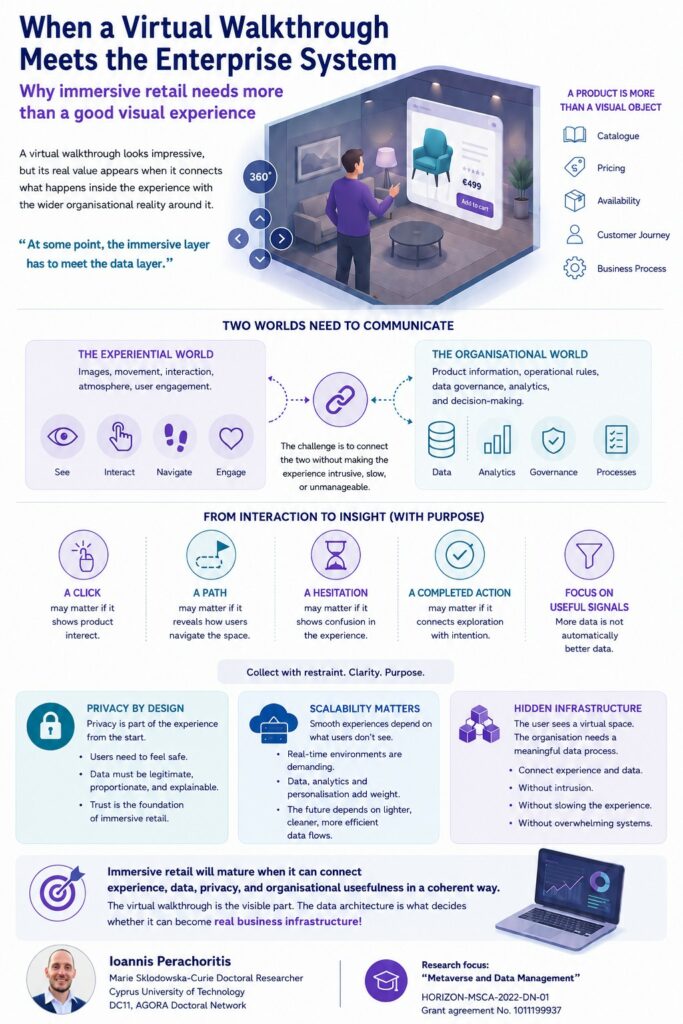
A virtual walkthrough does not become valuable only because it looks convincing. It becomes valuable when it can connect what happens inside the experience with the wider organisational reality around it. The product that appears in a virtual room is not only a visual object. It is part of a catalogue, a pricing structure, an availability system, a customer journey, and a business process. “At some point, the immersive layer has to meet the data layer”.
This is where many immersive experiences become fragile.
A user may move through a virtual environment, click on a product, compare options, follow a call-to-action, or leave without completing the journey. From the outside, these actions may look simple. In practice, they create data points that need to be interpreted. What did the user notice? Which object attracted attention? Which interaction mattered? Which moment produced interest, hesitation, or exit?
These questions are not only design questions. They are data questions.
The challenge is that immersive environments often sit between two worlds. On one side, there is the experiential world: images, movement, interaction, atmosphere, and user engagement. On the other side, there is the organisational world: product information, operational rules, data governance, analytics, and decision-making. Forimmersive retail to become more than a demonstration, these two worlds need to communicate.
That communication is not automatic.
Many organisations already have their own data structures, processes, and systems. Immersive platforms introduce another layer on top of them. If this layer remains disconnected, the virtual walkthrough may be visually impressive but strategically weak. It may create interest without producing useful knowledge. It may show products without helping the organisation understand how users engage with them. It may simulate a store without becoming part of the actual retail process.
This is why the real question is not only whether immersive retail can create attractive experiences. The deeper question is whether those experiences can become operationally meaningful.
A virtual walkthrough becomes meaningful when interaction data can be translated into insight without overwhelming the organisation or compromising the user. This requires careful decisions about what should be measured, what should be ignored, and what should never be collected in the first place. More data is not automatically better data. In immersive environments, the temptation to measure everything is strong. But collecting everything can create noise, risk, and mistrust.
The more responsible approach is to focus on useful signals.
A click may matter if it shows product interest. A path may matter if it reveals how users navigate the space. A repeated hesitation may matter if it shows confusion in the experience. A completed action may matter if it connects exploration with intention. But these signals should be collected with restraint, clarity, and purpose.
This also changes how we understand the role of privacy. Privacy is not only a legal requirement added at the end of a project. It is part of the design of the experience itself. Users need to feel that the environment is not watching them unnecessarily.Organisations need to know that the data they use is legitimate, proportionate, and explainable. Immersive retail depends not only on attention, but also on trust.
There is also a scalability issue hidden beneath the surface. Real-time immersive environments are already demanding. When interaction data, product information, analytics, and personalisation are added, the system becomes heavier. The smoother the experience appears to the user, the more work is happening behind it. The future of immersive retail will therefore depend not only on better graphics or better devices, but also on lighter, cleaner, and more efficient data flows.
This is the hidden infrastructure of immersive commerce.
- The user sees a virtual space.
- The organisation needs a meaningful data process.
- The challenge is to connect the two without making the experience intrusive, slow, or unmanageable.
Immersive retail will not mature simply by becoming more visually advanced. It will mature when it can connect experience, data, privacy, and organisational usefulness in a coherent way.
The virtual walkthrough is the visible part. The data architecture is what decides whether it can become real business infrastructure!
Ioannis Perachoritis is a Marie Skłodowska-Curie Doctoral Researcher at Cyprus University of Technology and DC11 in the AGORA Doctoral Network (HORIZON-MSCA-2022-DN-01, grant agreement No. 101119937). His research focuses on “Metaverse and Data Management”.